



COFEM participates in the conference on new technical criteria for smoke and ventilation control
COFEM continues to actively participate in the main technical forums of the fire protection sector, providing specialized knowledge and contributing to the advancement of safer, more efficient solutions adapted to the new needs of buildings and facilities.
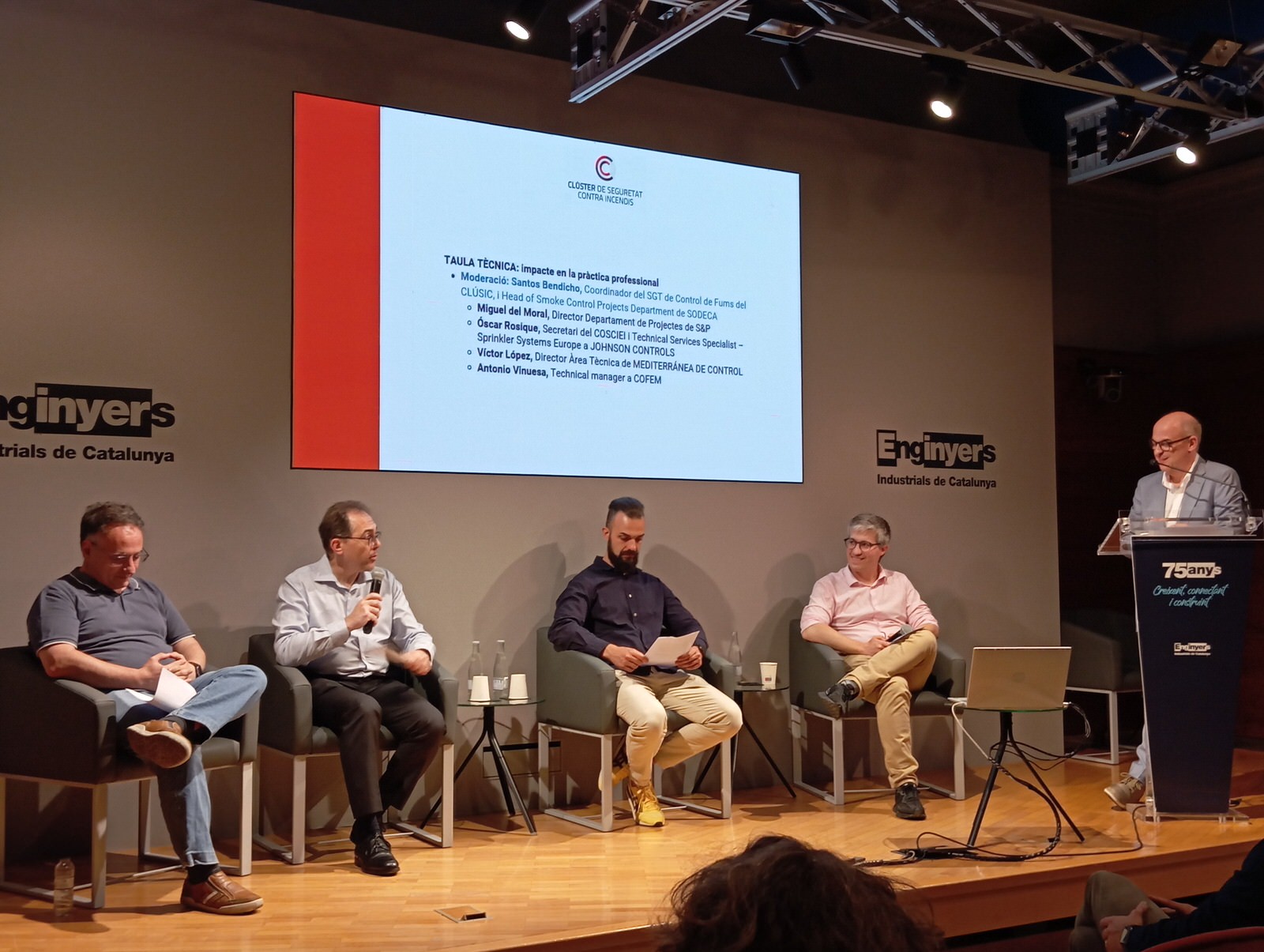
Last Friday, May 29, 2026, Antonio Vinuesa, Technical Director of COFEM and Chairman of the AENOR Standardization Committee on Fire Detection and Alarm Systems, attended the conference “New technical criteria in smoke and ventilation control”, organized by the Cluster of Fire Safety at the College of Industrial Engineers of Catalonia.
The session brought together industry professionals to analyze the design criteria for ventilation and smoke control systems in parking lots, a field that is becoming increasingly relevant due to the coexistence of different safety, energy efficiency and personal protection needs.
 Ventilation, detection and smoke control in parking lots
The conference focused on discussing the main aspects to be taken into account in the design of a smoke control ventilation system for parking lots, especially in a context where these spaces must simultaneously meet different technical requirements.
Based on the presentation of the UNE 100166 standard, an innovative proposal was presented to integrate in a single ventilation system the detection of toxic gases, smoke extraction in case of fire and the dilution of explosive gases, all with an approach oriented to energy efficiency.
Special attention was also paid to the importance of ensuring compatibility between all the systems involved in fire safety, such as fire detection, sprinkler activation and smoke extraction. This coordination is key both to facilitate the evacuation of the occupants and to help the fire departments to access the source of the fire and extinguish it.
New ventilation flow calculation criteria
During the session, a method for calculating the ventilation flow rate based on the source fire load, as proposed by the UNE 23589 standard, was also discussed.
This approach requires higher ventilation flow rates than those contemplated in other regulations, which opens a relevant technical debate on the sizing of the systems and their adequacy to the new risk scenarios present in modern parking lots and buildings.
The evolution of these criteria highlights the need to continue moving towards fire protection solutions that combine safety, technical efficiency and regulatory compliance.
Electric vehicles, a new challenge for fire detection
Finally, Antonio Vinuesa participated in a panel discussion representing the field of fire detection in parking lots. During his speech, he addressed the growing importance of the incorporation of electric vehicles and their impact on fire protection criteria.
In this regard, it was commented that the proposal for the current modification of the CTE DB SI seems to be oriented towards making it compulsory to have detection systems in all cases, especially in view of the new risks associated with the electrification of parking lots.
The preventive detection of an electrical leak in electric vehicles is still a complex challenge today. For this reason, the importance of having detection systems designed on the basis of optical detection and correctly maintained was emphasized, with the aim of favoring a rapid initiation of the fire warning.
From COFEM we value very positively the participation in this type of technical conferences, which allow to share knowledge, analyze regulatory developments and advance in detection and fire protection solutions increasingly prepared for new security challenges.